Rethinking Supply Chains for the Energy Transition Era
As demand for substations, transformers, and EV infrastructure surges, supply chains are hitting breaking point. Discover why smart sourcing strategies are key to keeping the energy transition on track.
Key Takeaways
Demand is outpacing supply chains: Energy projects are scaling faster than suppliers can keep up.
Bottlenecks risk progress: Delays, costs, and shortages threaten climate goals and energy security.
Market pressures add strain: Price swings, mineral concentration, and labor gaps deepen vulnerabilities.
Old procurement models fall short: Diversification, substitution, and integration are now essential.
Digital tools enable resilience: AI-powered procurement helps expand suppliers and speed innovation.
The global energy transition is no longer a slow evolution, it's a race. Across the world, governments are rolling out ambitious climate targets, and corporations are doubling down on electrification, renewable energy, and e-mobility initiatives. Energy infrastructure investment hit USD 1.4 trillion in 2022, driving 70% of total energy sector investment growth. What once unfolded over decades is now happening in just a few short years.
But with this rapid transformation comes a critical challenge: the physical infrastructure needed to support it, from substations and grid expansions to charging networks, is struggling to keep up. Energy companies that once built one substation a year are now tasked with building four; global EV production is predicted to grow six-fold by 2030. And yet, supplier networks and assembly partners weren’t built to scale at this pace. Furthermore, expansion plans for crucial materials might fall short significantly due to geopolitical/trade challenges and subsequent price volatility.
As demand for infrastructure surges, traditional sourcing models are showing their limits. The industry is hitting a bottleneck—one not caused by lack of ambition, but by supply chain capacity. To stay ahead, energy players must rethink procurement entirely. Tools like AI-powered supplier discovery platforms are emerging as essential allies in navigating this high-stakes transformation.
Market Pressures and Supply Chain Constraints
Global energy demand rose by 2.2% in 2024 compared to the average annual increase of 1.3% over the previous decade, creating substantial pressure on supply chains supporting energy transition projects.
The New Demand
The global shift from fossil fuels to electrification and renewable power is reshaping the very foundation of the energy sector. Solar parks, wind farms, battery storage systems, and EV charging stations are no longer “future plans”, they’re urgent priorities. The grid must adapt rapidly, not just to handle new sources of energy, but to manage an entirely different kind of demand.
Take the example of German transmission grid operator Amprion who, together with Hitachi Energy, signed over €2 billion in contracts to build four HVDC converter stations as part of the “Korridor B” project—designed to transfer large-scale wind power from the North Sea to central Germany by the early 2030s. This isn't just a single substation, it’s a major infrastructure buildout quadrupling the typical rate.
This isn't an isolated case. Across the sector, infrastructure projects are being scaled up at unprecedented rates. But this scale demands:
Vast amounts of raw materials and components,
Specialized engineering expertise,
And streamlined, high-speed procurement processes.
Raw Material Price Volatility
Essential materials for renewable technologies experienced significant price movements between 2020 and mid-2022. Polysilicon prices increased by 350%, while steel, copper, and aluminum saw two to threefold increases. Battery metals faced similar pressures, with lithium prices nearly quadrupling between 2019 and 2022.
Geographic Concentration Risks
Supply chain chaos stems from critical minerals being concentrated in few locations:
The Democratic Republic of Congo supplies 70% of global cobalt
China processes 90% of rare earth element
Indonesia provides 40% of nickel
These concentration levels, combined with pandemic disruptions and geopolitical tensions, create vulnerability points across energy transition supply networks.
In Japan, the offshore wind sector has hit a temporary standstill as the government reviews and revises its rules for auctioning offshore wind development rights. This regulatory uncertainty has already had tangible consequences: Danish wind turbine giant Vestasscrapped plans to build a new production facility in Nagasaki after failing to secure orders from the winners of a previous auction round.
This example reflects broader industry challenges, with 74% of renewable energy businesses reporting higher-than-expected supply chain losses over the last two years.
Workforce & Capacity Limitations
The renewable energy sector faces additional bottlenecks beyond raw materials. Workforce shortages affect 32% of companies, with difficulties attracting and retaining talent cited as a primary concern. Specialized installation capacity remains severely constrained—only nine vessels worldwide were equipped for large-scale turbine installation in 2020.
These capacity constraints require substantial investment to address. Industry analysis indicates current mining production pathways cannot accommodate projected growth, requiring over $700 billion in mining investment with 75% needed by 2030 to avoid critical shortages.
Many current suppliers were never designed to handle today’s demand. They may be reliable and well-established, but their production lines, tooling capabilities, or certification scopes simply don't stretch to meet this new scale and speed. Even the most trusted partners can become bottlenecks if they lack the capacity to grow with your needs.
Companies addressing these challenges successfully implement digital procurement platforms and AI-powered supplier discovery tools. These technologies enable rapid identification of alternative suppliers, reduce geographic concentration risks, and build supply network resilience, critical capabilities for energy transition project success.
Impact on Energy Infrastructure Projects
Supply chain constraints now create measurable operational challenges across the energy sector. Power transformer procurement times have doubled since 2021, extending acquisition periods to four years. Cable costs have nearly doubled in real terms since 2019, while power transformer prices increased approximately 75%.
These constraints manifest in three critical areas:
Project delays and cancellations: Energy companies reported a 30% increase in supply chain disruptions in early 2024 alone, with an average response time of two weeks to these disruptions. For large-scale infrastructure builds like substations, wind farms, or transmission upgrades, even short delays can create cascading impacts across multiple contractors and timelines.
Cost overruns. Each day of delay adds financial burdens through continued fixed expenses, rising interest payments, and potential contract renegotiations.
Energy security risks. When infrastructure projects stall, so does the transition to renewable power. Grid operators forced to delay renewable integration or storage projects often have no choice but to fallback on fossil fuel-based generation to maintain supply and avoid blackouts. This creates a dangerous paradox: short-term reliability is achieved at the cost of long-term climate goals.
An Industry-wide Concern
This isn't one company’s problem. The current supply chain strain is a systemic issue affecting every corner of the energy sector:
Utility companies face the pressure of maintaining grid reliability while rapidly scaling capacity.
Infrastructure builders are caught between ambitious project demands and supplier limitations.
OEMs (Original Equipment Manufacturers) struggle to ramp up production of transformers, cables, switchgear, and other components at the speed required.
Even the best-laid project plans are now at risk of falling behind. Without scalable supplier strategies, the sector risks not just falling short, but falling apart under its own momentum.
Building Supply Chain Resilience Through Strategic Procurement
Energy companies face supply chain vulnerabilities that require immediate strategic response. The Covid-19 pandemic and Russia's invasion of Ukraine have created major disruptions to global energy technology supply chains, highlighting the urgent need for strategic transformation.
Procurement leaders should focus on four critical resilience strategies:
Diversify geographic sourcing by establishing multiple suppliers across different regions to reduce dependence on single locations or suppliers.
Explore cross-industry procurement opportunities to pool resources and strengthen bargaining power.
Invest in recycling and material substitutionresearch to decrease reliance on scarce raw materials.
Consider vertical integration through strategic partnerships or acquisitions to secure critical materials
RWE, Wales' largest renewable energy generator, demonstrates effective supplier engagement through its Supplier Transparency & Engagement Program (STEP). The initiative maximizes opportunities for businesses to support offshore wind development through new websites, engagement platforms, supplier events, and direct project team access. This supplier discovery program has enabled RWE to work with Tata Steel UK, ABP Port Talbot, and other key regional suppliers.
Digital Procurement Implementation
The pressure to scale infrastructure quickly has exposed the limitations of traditional supplier networks. Digital procurement platforms offer significant advantages for energy companies managing complex supply chains with regulatory hurdles.
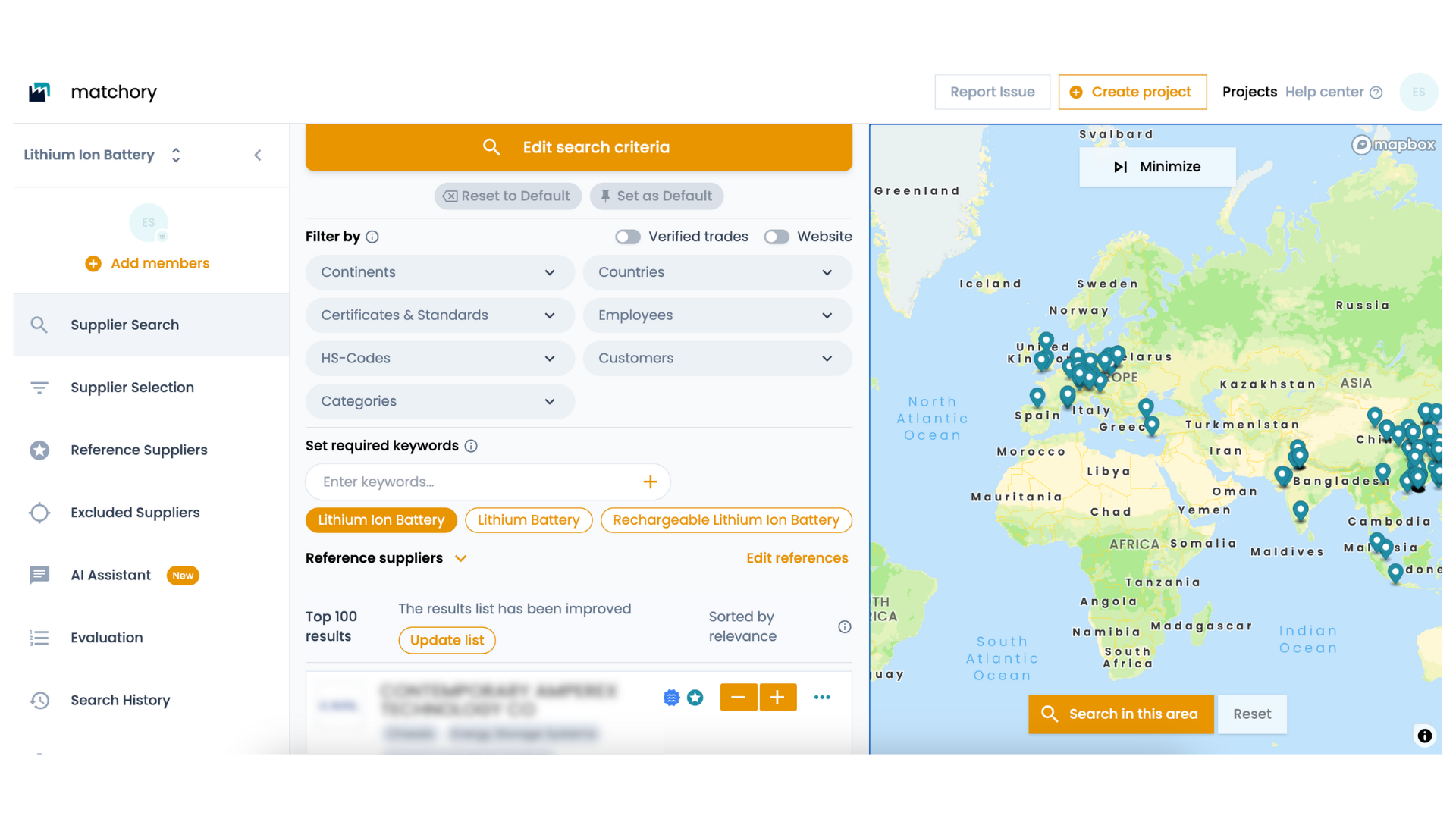
AI-powered tools like Matchory can help energy companies adapt by enabling fast, data-driven supplier discovery, surfacing global manufacturers that meet specific technical and compliance requirements, with filters like certificates or sustainability topics. Moreover, your R&D and technical teams can accelerate knowledge discovery with Matchory’s AI assistant. When exploring complex fields like energy storage or battery technology, users can ask questions like “show me the latest innovations in this area” and instantly access up-to-date insights on latest technologies and functionalities—turning supplier search into a tool for technical exploration.
Matchory's discovery tool supplier world map
Instead of relying on outdated databases or manual research, procurement teams can gain transparency into global supply markets, compare supplier capabilities, and expand their sourcing pipeline with confidence. This approach helps companies avoid delays, reduce dependency on overstretched vendors, and build more resilient supply strategies for the energy transition.
Conclusion
The energy transition faces a critical turning point. Supply chain vulnerabilities threaten decarbonization goals, as shown by quadrupling lithium prices and doubled procurement times for essential components. These disruptions affect everyone from utility operators to renewable technology manufacturers and without doubt slow the pace of change when we need acceleration most.
Digital procurement systems are not just convenient tools but essential solutions to navigate these unprecedented challenges. A multi-faceted approach provides a roadmap to future-proof your operations through geographic diversification, collaborative effort, materials state-of-the-art, and mutually beneficial alliances. The cost of inaction ends up nowhere near the investment and organizational commitment needed for these changes.
The energy transition will continue whatever individual organizations do to prepare. Your priority should move toward building adaptable, resilient supply chains that can withstand predicted challenges and unexpected disruptions. The real question isn't whether to transform your procurement approach, but how quickly you can implement digital solutions to secure your position in tomorrow's decarbonized digital world.