Friendshoring Explained: Build Stronger Supply Chains in Uncertain Times
Explore how friendshoring is helping companies reduce risk, strengthen supply chain resilience, and meet ESG goals—enabled by modern digital procurement tools and trusted global partnerships.
Key Takeaways
Friendshoring is a response to global risk. Companies are shifting sourcing to politically aligned, low-risk countries.
It goes beyond location: values, governance, and regulatory alignment are key factors.
ESG and compliance drive decisions. Ethical sourcing is now a strategic priority.
The shift is real and growing: major brands are moving production to India, Vietnam, Mexico, and Eastern Europe.
AI tools make it scalable
In a world increasingly defined by geopolitical uncertainty, economic nationalism, and global disruption, traditional supply chains are under unprecedented pressure. Companies that once relied on low-cost, offshore manufacturing are now rethinking their sourcing strategies to reduce risk and increase resilience. This reality is reflected in executive priorities: 73% of global executives now rank geopolitically aligned supply chains as a top priority.
One emerging solution is friendshoring. The concept first appeared in a White House report on supply chain resiliency in mid-2021, defining the practice as rerouting supply chains to countries perceived as politically and economically safe or low-risk. Unlike reshoring (bringing production back home) or nearshoring (moving production to neighboring regions), it focuses on building trade relationships with trusted partners who share common values and regulatory frameworks.
As global trade realigns, friendshoring is quickly evolving from a buzzword into a strategic imperative. US-China tensions, EU sanctions on Russia, and disruptions like the COVID-19 pandemic and Red Sea shipping interruptions have exposed vulnerabilities in global supply networks. Companies face a stark choice: maintain traditional cost-focused sourcing or adapt to new realities.
Forward-thinking organizations are turning to data-driven platforms and AI-powered tools to navigate this new landscape, making smarter, faster decisions about where and with whom they do business.
Understanding the Evolution of Global Sourcing Models
Global sourcing strategies have changed dramatically in the last few decades. Economic pressures, technological advances, and changing risks have shaped this transformation.
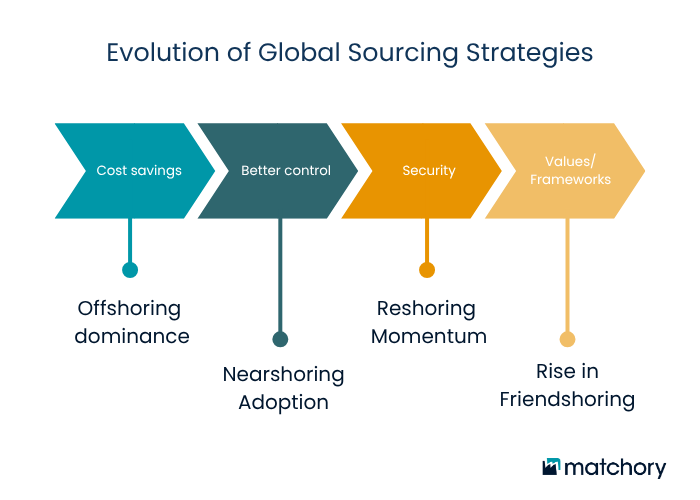
From offshoring to nearshoring and reshoring
Offshoring dominated global sourcing for decades, driven by the appeal of lower labor costs in distant countries. Manufacturing companies accelerated this practice throughout the 1970s, seeking competitive advantages through cost reduction. While the model worked well initially, inherent limitations became apparent over time. Long lead times complicated production scheduling, quality control challenges increased operational complexity, and intellectual property risks created new vulnerabilities.
These challenges prompted companies to explore alternatives. Nearshoring emerged as companies relocated operations to neighboring countries with stronger shipping links and communication channels. This approach offered a middle ground: maintaining cost advantages while providing greater operational control than traditional offshoring. Reshoring gained momentum simultaneously, with companies bringing manufacturing back to domestic markets to regain supply chain control and reduce external risks.
The rise of friendshoring as a strategic shift
"Friendshoring means… that we have a group of countries that have strong adherence to a set of norms and values... and we need to deepen our ties with those partners and to work together to make sure that we can supply our needs of critical materials." — Janet Yellen, U.S. Treasury Secretary
Friendshoring represents the latest evolution in global sourcing strategy. Unlike previous models that emphasized geography or cost optimization, friendshoring prioritizes countries that share similar values, political interests, and regulatory frameworks.
This approach marks a significant strategic shift. Companies now evaluate suppliers based on multiple criteria beyond cost efficiency:
Political stability and shared economic interests
Regulatory alignment and governance standards
Lower risk of disruption from sudden policy changes or trade disputes
This makes friendshoring especially appealing for businesses seeking long-term stability in an unpredictable global landscape. By prioritizing trust and alignment over cost alone, friendshoring helps companies de-risk their supply chains while still tapping into global talent and capacity.
Key Drivers Behind the Friendshoring Trend
Several powerful forces drive the surge in friendshoring across global industries today.
Geopolitical instability and trade fragmentation
Trade conflicts have completely disrupted traditional supply networks. The US-China trade wars led to tariffs covering approximately two-thirds of their bilateral trade. Russian invasion of Ukraine triggered sanctions that created ripple effects throughout global energy and commodity markets.
Ground data shows clear effects: trade flows respond much more to geopolitical distance since the Ukraine war started. Trade between hypothetical East and West blocs grows 4% slower than trade within these blocs. Nations now focus on economic resilience and national security, which reflects growing protectionist tendencies.
Rising labor costs in traditional hubs
Traditional manufacturing hubs face dramatic economic changes. Labor costs in regions like Guangdong, China have jumped 10-15% each year. These increases eat away at cost benefits that drew global businesses originally. This smaller cost gap makes friendshoring a viable option when weighed against other benefits.
Demand for faster, more resilient supply chains
Supply chain vulnerabilities became clear during the pandemic. A 2019 EY survey of 500 executives showed end-to-end visibility as the key factor for successful supply chains.
Companies learned that resilience requires:
Digital capabilities like control towers that use AI to predict disruptions.
IoT devices and sensors to monitor distribution networks instantly.
Digital twin technology to test what-if scenarios.
Consumer and investor pressure for ethical sourcing
Ethical factors shape sourcing decisions heavily. Almost 90% of large companies release sustainability reports to show responsible supply chain practices. The stakes run high: research consistently shows that a significant percentage of consumers, often around 70-80%, are more likely to buy from or remain loyal to brands that show responsible corporate behavior. This makes ethical practices both morally right and financially smart.
Real-World Examples and Regional Shifts
Friendshoring offers a practical middle ground. It allows businesses to maintain access to global manufacturing while reducing exposure to volatile or adversarial regimes. For instance, the U.S. Inflation Reduction Act incentivizes companies to source critical materials from allied nations. Similarly, EU trade policies are increasingly favoring partners that align with democratic values and sustainability goals. In general, several regions have become preferred alternatives for manufacturing and sourcing.
Apple's move to India and Vietnam
Apple shows how companies transform their manufacturing base by moving some iPhone production from China to India. Only 5% of Apple products come from outside China, but this number could reach 25% by 2025. Apple CEO Tim Cook stated that "the majority of iPhones sold in the US will have India as their origin, and Vietnam for almost all iPad, Mac, Apple Watch, and AirPods". The numbers tell the story: by late 2024, Vietnam assembled 20% of iPads and 90% of AirPods. This new strategy helped reduce tariff risks.
Overall, India and Vietnam have established themselves as trusted friendshoring partners for Western companies. India's electronics exports to the US reached EUR 6.30 billion between January-September 2023. Big brands like Samsung, Nike, Adidas, LG, and Foxconn have moved their operations from China to Vietnam. This creates more geographically diversified supply chains.
U.S. companies sourcing textiles from Mexico
Mexico has become the main textile market and sourcing hub for US companies after the USMCA agreement. The country now exports more denim apparel to the US than China. Mexico's textile industry provides jobs to about 639,000 workers. The numbers back this trend: manufacturing imports from Mexico to the US grew 10% between 2017-2018 and another 4% between 2018-2019.
Eastern Europe's rise as a manufacturing hub
Eastern Europe has transformed into a thriving industrial zone. Poland, Romania, and Slovakia attract record foreign investments thanks to several advantages:
Industrial wages 40-60% lower than Western Europe.
Close location to major markets like Germany and France.
EU structural funding exceeding EUR 110 billion between 2021-2027.
Challenges and Trade-Offs
While friendshoring brings clear benefits, it also presents challenges. Higher labor and operational costs in friendshoring countries can impact pricing. Supplier options may be more limited, especially for specialized components, requiring longer qualification times.
Companies must also navigate cultural, regulatory, and infrastructure differences, which can complicate logistics and compliance. Additionally, concentrating suppliers in a few allied countries can create new risks if those regions face disruptions. Overcoming these challenges requires strong data, risk assessment, and strategic planning supported by advanced tools.
Tools and Strategies to Enable Friendshoring
Companies seeking to implement friendshoring strategies need specialized tools and approaches that can navigate complex supplier ecosystems across politically aligned regions effectively.
AI-powered supplier discovery platforms
Modern AI-powered platforms have changed how companies identify trustworthy suppliers in allied nations. Matchory, a leading solution in this space, maintains a database of over 14 million global supplier profiles. You can reduce supplier discovery time from two months to just two days.
Platforms in this space analyze supplier reliability, performance metrics, and potential risks including economic instability or poor labor practices. Companies like PepsiCo access over 60 data points per supplier, covering location, certifications, and ESG insights. This comprehensive data analysis enables informed decision-making for strategic supplier selection.
Building multi-country sourcing networks
A smart multi-country strategy makes friendshoring work better. Marks & Spencer learned that sourcing from India, Bangladesh, Cambodia, and Vietnam needed local solutions to make supply chains better. Companies can build successful networks across multiple countries despite different logistics and cultural norms through:
Strong relationships with local suppliers.
Solid education programs to help vendors learn new processes.
Immediate visibility platforms that link factories, carriers, and warehouses.
Aligning with ESG and compliance standards
ESG factors now shape friendshoring decisions directly. Companies are expected to ensure that their supply chains reflect ethical labor practices, environmental responsibility, and transparent governance, particularly when relocating operations to new regions.
Matchory supports this shift by offering visibility into global supplier networks, including automated access to key sustainability and compliance data. The platform enables procurement teams to filter suppliers by ESG criteria and certifications (such as ISO, SA8000, BSCI, etc.), helping businesses quickly identify partners that meet both operational and ethical standards. This makes it easier to build resilient, values-aligned supply chains without compromising on transparency or due diligence.
Collaborating with governments and trade bodies
Government partnerships are vital to friendshoring success. Ten Western states and the EU have formed the Minerals Security Partnership (MSP). This ensures critical minerals like cobalt and lithium come from member states that share geological resources with friendly nations. Companies can also use EU investments, including the €43 billion for the semiconductor industry, to create more secure supply chains.
Conclusion
Friendshoring is becoming a proactive strategy for building more resilient, responsible supply chains. By shifting sourcing to politically aligned and economically stable countries, companies can reduce exposure to geopolitical shocks while aligning with growing demands for transparency, sustainability, and ethical production. Though friendshoring may involve trade-offs, such as higher costs or smaller supplier bases, the long-term value lies in supply chain continuity and reduced strategic risk.
To make friendshoring work at scale, companies need the right tools. AI-powered platforms help identify qualified suppliers in trusted regions with speed and precision, replacing months of manual research with actionable insights in days. As global trade continues to fragment and regulatory pressures increase, companies that invest in smarter, values-aligned sourcing strategies will be better positioned to compete and grow in an uncertain future.