Financial Health: the Missing Link in Supplier Discovery
Why is financial health the missing link in supplier discovery? Learn how AI-powered supplier matching combined with financial risk data helps procurement teams avoid costly disruptions and build stronger, more resilient supply chains.
Key Takeaways
Financial health matters: Technical ability alone isn’t enough—suppliers need financial stability.
Traditional discovery is limited: Manual checks and basic metrics can miss hidden risks.
Prevent risks early: Financial checks reduce disruptions and replacement costs.
Build resilient supply chains: Integrating financial intelligence makes procurement strategic.
Imagine this: you’ve just onboarded a supplier who checks every box—technical capabilities, certifications, competitive pricing. Six months later, they default due to cash flow issues, leaving your supply chain scrambling, costs rising, and deadlines slipping. Scenarios like this are more common than many think. In fact, over 80% of organizations have faced supply chain disruptions in the past two years, and poor supplier finances are often at the core. Yet financial health remains one of the most overlooked factors in supplier discovery.
Relying only on capabilities, certifications, and compliance creates blind spots. A supplier can look perfect on paper but still be financially unstable, exposing your organization to sudden breakdowns, costly replacements, and reputational risks. Without a view into creditworthiness and financial resilience, procurement teams are taking unnecessary risks.
The path forward is linking supplier discovery with financial risk analysis. By combining AI-powered supplier research with integrated financial data, procurement teams gain a truly comprehensive view: seeing not only what suppliers can do, but whether they’re built to last. In the following sections, we’ll explore why financial health is the missing link in supplier discovery and how bridging this gap creates stronger, more resilient supply chains.
The Gaps in Current Supplier Discovery Practices
For decades, supplier discovery relied on manual research, word of mouth, or limited databases. Procurement teams typically evaluated suppliers based on technical capabilities, on-time delivery, and cost performance. While this approach helped ensure suppliers could deliver in the short term, it was resource-intensive, slow, and prone to incomplete or outdated information.
New digital platforms have transformed this process. AI-driven discovery tools now allow procurement teams to search globally, verify certifications, and filter by ESG criteria or industry standards. This shift has made it faster and more reliable to find qualified suppliers and compare them across multiple dimensions—unlocking efficiency and transparency that traditional methods couldn’t match.
But even with these advances, one crucial piece is still missing: financial health. Without insight into revenue stability, creditworthiness, or bankruptcy risk, procurement teams may gain confidence in what a supplier can do while overlooking whether they are financially able to sustain performance.
The illusion of supplier reliability without financial checks
Not checking financial health creates false confidence. In one audit of 22,000 supposedly active supplier records, 14.5% were no longer operating—some were in insolvency proceedings or winding down—and another 7% couldn’t be verified with the information provided.
This false reliability becomes risky especially when you know that low prices aren't the main factor in picking suppliers anymore. Companies want strategic collaborations that guarantee high-quality parts. But even the most capable supplier becomes a huge risk without financial stability.
The Risks of Ignoring Supplier Financial Health
Not paying attention to your supplier's financial health can get pricey and create a ripple effect across your supply chain. A supplier's performance depends directly on their financial stability; poor finances often signal upcoming operational problems.
Real-life consequences: delays, defaults, and disruptions
Financial troubles usually lead to delayed deliveries, quality compromises, and unexpected production halts. Suppliers who cut corners to save money often make defective products that lead to more customer complaints or product recalls. A perfect example happened in 2024 when an automotive seat supplier filed for insolvency and stopped a major OEM's production for months. Price swings become inevitable as financially troubled suppliers struggle to handle their costs.
Cost of replacing a failed supplier mid-contract
Supplier failure costs are nowhere near limited to the original disruptions. The Big Three auto manufacturers faced a massive EUR 507.64 million in costs when auto parts supplier Collins & Aikman went bankrupt. These costs included loan cancelations, price increases, operating subsidies, and legal fees. Finding a replacement supplier needs complex steps like solicitation, shortlisting, contract negotiation, and vendor training, while keeping current services running.
Impact on brand reputation and operational continuity
Supply chain disruptions caused financial losses for 43% of organizations last year—and the damage goes beyond money. Delays, shortages, and broken promises erode customer trust, putting brand reputation and market position at risk for years.
The solution is a layered procurement strategy that includes proactive financial risk assessment. By combining AI-powered supplier discovery with financial data, procurement teams can identify reliable, financially stable partners early, shifting from reactive problem-solving to true risk prevention.
Bridging the Gap with AI and Financial Intelligence
Modern procurement requires finding capable suppliers that can deliver consistently over time. That’s why combining AI-powered supplier discovery with financial intelligence is such a powerful step forward.
With Matchory, procurement teams can already search globally, compare suppliers across certifications, ESG criteria, and capabilities, and build a shortlist with unprecedented speed and accuracy. Through our partnership with Creditsafe, we add the missing layer: financial risk analysis. Clients can access detailed financial risk reports directly within the platform, giving them instant visibility into a supplier’s credit rating, revenue trends, and risk of insolvency.
This integration transforms supplier discovery from a search exercise into a strategic risk management process. Teams can not only identify the best-fit suppliers but also validate their long-term financial resilience before contracts are signed. By downloading financial risk reports alongside discovery data, procurement professionals gain a complete, actionable view of every supplier.
The result is confidence. Confidence that the supplier is technically capable, aligned with compliance standards, and financially stable enough to support reliable delivery. It’s a more holistic, data-driven approach that equips procurement teams to build partnerships that last.
Benefits for Procurement Teams
Integrating supplier discovery with financial health checks creates immediate and long-term advantages for procurement, enabling more strategic, confident decision-making.
Key benefits include:
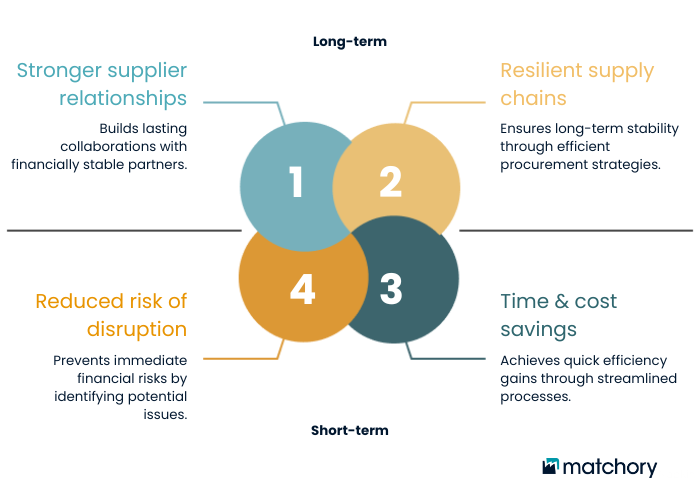
Reduced risk of disruption: Financial risk reports highlight potential red flags before contracts are signed, helping teams avoid suppliers at risk of insolvency.
Time and cost savings: AI-powered discovery streamlines the search process, while integrated financial checks prevent costly mistakes from onboarding unstable partners.
Stronger supplier relationships: Partnering with financially sound suppliers supports consistency, reliability, and the ability to build long-term strategic collaborations.
Resilient supply chains: Combining operational and financial data ensures procurement strategies are designed not just for efficiency, but for continuity and stability.
Together, these benefits move procurement from a reactive, problem-solving function to a proactive, strategic driver of resilience and value creation.
Conclusion
Financial stability is no longer a “nice-to-have” in supplier evaluation: it’s a critical factor in building resilient supply chains. Traditional discovery focused on technical ability and compliance, and modern platforms like Matchory have expanded this view with AI-driven insights and ESG data. But without financial intelligence, even the most advanced discovery process leaves procurement teams vulnerable to disruption, costly supplier failures, and reputational damage.
By integrating Creditsafe’s financial risk data directly into the supplier discovery process, procurement teams gain a complete and actionable perspective: identifying the best-fit partners while validating their long-term resilience. This combination transforms supplier discovery into a strategic risk management tool that helps organizations move beyond firefighting and toward building supply chains that are not only efficient, but also dependable and future-proof.