Digital Procurement Success: Building Your Ecosystem the Right Way
In today’s fast-paced, risk-heavy global landscape, procurement leaders are expected to deliver more than just cost savings. They’re under pressure to drive innovation, build resilient supply networks, and contribute to overarching business strategy. Yet many are stuck fighting an uphill battle: working with outdated tools, siloed systems, and procurement suites that promise integration but deliver rigidity.
Key Takeaways
Legacy procurement tools are failing: outdated, rigid suites create silos, poor user experience, and high costs.
Adopt step-by-step transformation: assess maturity, target pain points, implement quick wins, ensure data interoperability, and scale gradually.
The reality looks grim: 17% of procurement leaders don't have a digital procurement strategy. Too often, organizations rely on monolithic, mediocre technology stacks that can’t keep up with the speed and complexity of modern supply chains. Instead of empowering teams, these systems create friction, limit visibility, and stifle innovation.
To meet today’s challenges — and tomorrow’s — procurement needs to break free from legacy thinking. A well-built digital procurement ecosystem can reshape the scene. It cuts cycle times by up to 80% and gives suppliers and internal requesters complete transparency. The future lies in a modular, data-driven digital ecosystem built on interoperability, real-time insights, and best-of-breed solutions.
In this piece, you'll learn to build a procurement ecosystem that delivers results. You'll find why modular, best-of-breed tools work better than monolithic suites. We'll show you how to set up a system that gives your team the flexibility and immediate insights needed for strategic decisions.
Modern businesses find traditional procurement approaches inadequate, and yet, research shows 82% of businesses continue to use decentralized, reactive, and manual procurement processes. For years, enterprise procurement has been dominated by massive ERP suites and legacy platforms that claim to be “all-in-one” solutions. While these systems offer a certain level of control and standardization, they often fall short where it matters most: adaptability, speed, and insight.
Procurement teams today operate in an environment where supply disruptions, geopolitical shifts, sustainability demands, and inflation are the norm, not the exception. Yet many are still forced to rely on tools that were designed for a different era.
Rigid workflows & poor user experience
Rigid procurement systems slow teams down, especially during urgent or exception-based purchases. To cope, users often resort to emails and spreadsheets, delaying decisions and increasing risk. Overall, clunky, poorly designed portals make things worse. When tools are hard to use, employees avoid them, driving maverick spending that can add 15-20% in unnecessary costs.
Lack of live spend analysis & supplier visibility
Despite having plenty of spend data, procurement teams often lack useful insights. Because disconnected systems and siloed data limit visibility, only 43% of organizations truly understand their Tier 1 suppliers. This creates blind spots in performance, risk, and opportunity, as teams rely on outdated data instead of real-time insights.
Over-reliance on outdated suite-based solutions
Many organizations invested in procurement suites that overpromised and underdelivered. These one-size-fits-all platforms often miss the mark, with poorly integrated modules, weak sourcing intelligence, and analytics tools not built for everyday users. The cost is high: outdated processes can drain over €13 million annually, while professionals spend up to 60% of their time on low-value tasks. The answer is a modern, flexible digital ecosystem made up of purpose-built, interoperable tools tailored to real procurement needs.
What a modern digital procurement ecosystem looks like
Procurement technology has changed to welcome flexible, interconnected systems. These systems now provide specialized features instead of one-size-fits-all solutions. A modern procurement ecosystem needs a modular, cloud-based ecosystem built on best-of-breed tools. These tools must be interoperable, using APIs and smart integrations to ensure data flows seamlessly across platforms.
Modular, best-of-breed tools over monolithic suites
Leading procurement teams now embrace a hybrid approach, combining S2P platforms with best-of-breed tools tailored to business needs. KPMG notes that while core platforms automate tasks, specialized solutions offer deeper capabilities and vendor expertise without the rigidity of being locked into a single system.
Open architecture with API-first integration
Seamless connectivity is essential for digital procurement. APIs enable smooth data exchange across tools, supporting the best-of-breed approach. Instead of outdated point-to-point links, companies need to create a unified, data-driven ecosystem by implementing a modern integration architecture that connects procurement platforms with ERPs, supplier databases, and finance systems creating a unified, data-driven ecosystem.
Real-time data access & intelligent automation
Quick decision-making is critical in modern procurement. Live reporting and automation give managers real-time visibility across the procurement cycle, enabling faster responses to supply chain disruptions. For example, pricing analysis that once took two days can now be done in under ten minutes. This shift has transformed spend analysis from a backward-looking task into a strategic, forward-facing capability.
Successful implementation of digital tools results in a system that delivers real-time insights, automates routine tasks, and provides full visibility across the supply chain. Instead of working in silos, procurement teams gain a unified, flexible setup that evolves with business needs enabling smarter, faster, and more strategic decisions.
Key components of a high-performing ecosystem
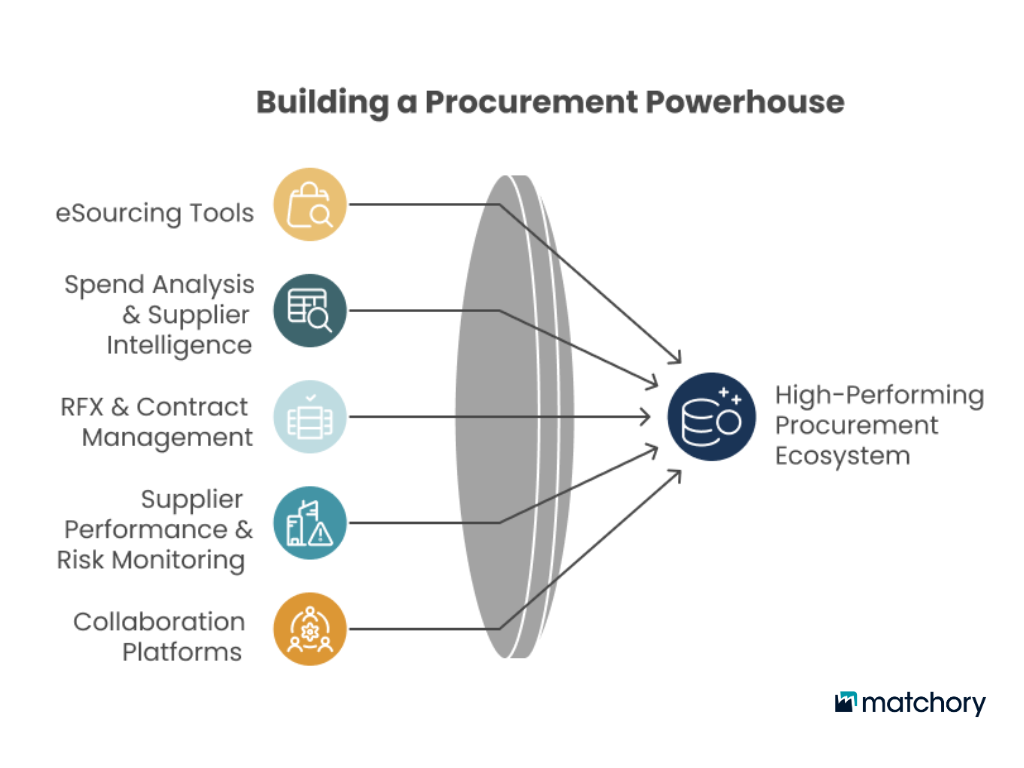
A successful procurement ecosystem combines specialized tools that tackle specific challenges in the procurement lifecycle. The ecosystem needs carefully selected integrated components that merge with one another.
1. eSourcing tools
AI-powered sourcing tools like Matchory stand at the forefront of procurement technology. These solutions provide deep visibility into global supply markets, enabling faster discovery of qualified, cost-effective alternatives. With extensive supplier databases and real-time data enrichment, Matchory helps teams stay ahead of market changes and new entrants. The result is smarter sourcing decisions and in some cases, reducing production costs by up to 50%.
2. Spend analysis & supplier intelligence
Effective procurement relies on strong spend analysis. The right tools clean, classify, and analyze complex spend data to uncover trends, reduce waste, and identify savings. Paired with supplier intelligence, they bring greater transparency and control.
3. RFX & contract management tools
RFx and contract management tools streamline vendor selection and improve outcomes through standardized processes. They boost efficiency, reduce risk, and enhance visibility across supplier relationships. Features like clause libraries, compliance checks, and milestone tracking help teams negotiate better deals and ensure contract adherence.
Reliable partnerships start with clear performance metrics. Modern tools use custom KPIs and scorecards to track both qualitative and quantitative data. Solutions like Matchory enhance this by assessing supplier risk, analyzing financial stability, geographic exposure, and supply chain resilience, so teams can act before issues escalate.
5. Collaboration platforms for internal and external stakeholders
Collaboration tools have become vital for cross-functional teamwork. These platforms enable seamless teamwork across functions and with vendors. They speed approvals, streamline vendor management, and support joint tasks like contract creation and RFPs.
How to build your ecosystem the right way
Building a successful procurement ecosystem needs careful planning and execution. Creating an effective system requires a balanced approach between current needs and future goals, unlike buying technology as a one-off purchase.
Start with a digital maturity assessment. Evaluate your people, processes, and tech to spot gaps and prioritize digitization.
Map user journeys and pain points. Involve cross-functional teams to identify bottlenecks and align on improvements.
Adopt agile implementation with quick wins. Focus on small, impactful changes like automating tasks and centralizing data to boost efficiency and cut costs.
Ensure data consistency and interoperability. Use accurate data and API-driven integration so all tools work seamlessly together.
Pilot, iterate, and scale. Test new tools in small settings, learn from feedback, and gradually expand to minimize risk.
Conclusion: Say No to Mediocrity, Build for the Future
Despite advances in digital procurement, many organizations still struggle with disconnected systems and poor visibility. Legacy tools cause bottlenecks, blind spots, and missed opportunities that hurt performance.
Shifting to a modular, best-of-breed ecosystem is a smarter, more flexible approach. Instead of forcing your team to adapt to rigid suites, choose specialized tools that integrate easily and solve real problems.
Start with a digital maturity assessment, identify key pain points, and roll out solutions in phases, focusing on quick wins to build momentum. Ensure data consistency and open integration to make tools work together seamlessly. Platforms like Matchory, with AI-driven supplier discovery and a rich global database, add real strategic value by enhancing visibility, reducing costs, and improving supplier relationships.
Ultimately, the goal is more than automation. It’s about building an intelligent, connected system that turns procurement into a strategic driver of value. The right ecosystem delivers long-term gains in agility, resilience, and competitiveness.