Future is human + AI: blending speed with expertise for best results.
Artificial intelligence is rapidly transforming the procurement landscape, from automating routine tasks to uncovering new supplier opportunities with impressive speed and precision. As these tools become more sophisticated, it’s natural for you to wonder: Will AI eventually replace my role?
This concern isn’t unfounded. Across industries, the rise of automation often raises questions about job security. But when it comes to procurement, the reality is far more collaborative than threatening.
AI in procurement changes the way you handle complex and time-consuming tasks. Your role remains essential as AI serves as your assistant, not your replacement. According to the Hackett Group, 64% of procurement leaders expect AI and Gen AI to transform their roles within five years. Yet, the human element remains crucial in this evolution.
In this article, we’ll explore how AI tools are not here to take over, but rather to support and empower category managers. These technologies are designed to enhance your expertise, streamline your workflows, and free you up to focus on what truly matters: strategic thinking, supplier relationships, and informed decision-making
AI in Procurement: What It Is and What It Isn’t
AI in procurement's true role becomes clearer when we understand what it can and cannot do. The right implementation of AI helps you analyze vast amounts of procurement data in minutes instead of weeks. This technology spots patterns across thousands of transactions, contracts, and supplier interactions. It uncovers insights you might miss on your own. However, AI provides insights, suggestions, and efficiency—not final decisions
Irreplaceable Expertise
Category managers are strategic advisors, negotiators, market analysts, and relationship builders. Their role requires a deep understanding of product categories, supplier dynamics, cost structures, and evolving market conditions. This expertise is built over years of experience, intuition, and industry knowledge—something no algorithm can replicate.
Beyond managing spend, category managers are responsible for complex decision-making that balances cost, risk, quality, sustainability, and long-term business goals. They build and maintain supplier relationships, navigate cross-functional stakeholder needs, and make judgment calls where nuance and context are critical.
While AI can process vast amounts of data in seconds, it cannot replace the human ability to weigh priorities or influence internal and external stakeholders. AI cannot grasp complex supplier relationships, negotiate based on subtle market forces, or make judgment calls based on organizational priorities. The technology lacks the contextual understanding and emotional intelligence that successful category management needs.
AI’s role
Let’s consider AI's actual functions in procurement:
Processing structured data at scale
Automating repetitive administrative tasks
Providing analytics-based decision support
Identifying patterns in large datasets
AI tools improve with your guidance. These systems learn from your data input and corrections. AI systems can reinforce existing biases or suggest actions based on partial information without human oversight.
The best procurement teams see AI as their partner. You contribute industry knowledge, supplier relationship management skills, and strategic thinking. AI adds speed, consistency, and data processing power to the mix.
Key Use Cases Where AI Assists
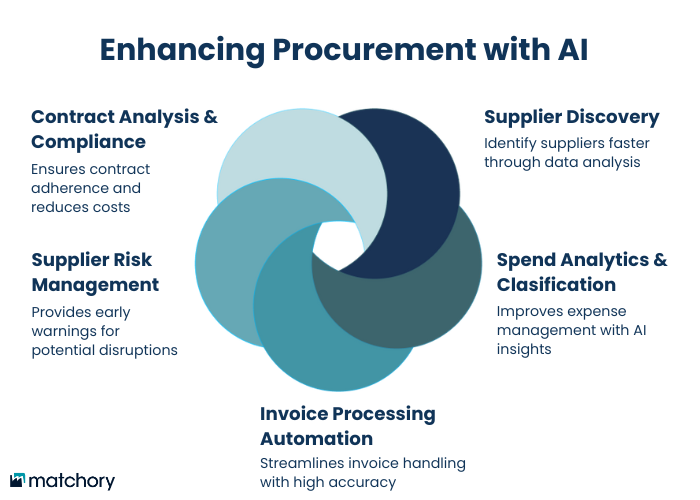
AI delivers measurable improvements across specific procurement functions like:
Supplier Discovery
AI-powered tools like Matchory accelerate the supplier discovery process by scanning millions of global data points. Instead of relying solely on referrals or manual searches, AI tools surface pre-vetted, relevant suppliers that meet your unique sourcing requirements. This not only shortens sourcing cycles but expands your access to innovative and cost-effective suppliers.
Spend Analytics & Classification
AI algorithms classify expenses across languages and regions with superior accuracy compared to manual methods. These systems detect patterns across supplier data, market trends, and currency fluctuations to uncover opportunities that traditional analysis might miss. Organizations using AI-powered spend intelligence report an average 20% reduction in procurement process costs.
Invoice Processing Automation
AI systems extract key data with up to 98% accuracy compared to 92% for human analysis. This precision reduces manual processing time significantly, allowing your team to focus on exceptions requiring judgment. With nearly 40% of accounting capacities currently tied up in invoice processing, this automation delivers immediate value.
Supplier Risk Management
AI tools monitor millions of data sources to provide early warnings about potential disruptions. They evaluate suppliers across multiple risk factors, accelerating the vetting process dramatically. Jaguar Land Rover's AI platform flagged a key supplier at risk two weeks before production impact, demonstrating how these tools enhance foresight capabilities.
Contract Analysis & Compliance
Automated document analysis and obligation tracking enable AI systems to extract key terms, flag potential risks, and ensure regulatory compliance. Companies can reduce manual contract management costs by over 50% through intelligent contract analysis.
The pattern remains consistent across all applications: AI handles repetitive, data-heavy tasks while you apply strategic thinking and relationship management where they create the most value.
How to Integrate AI into Your Procurement Workflow
Successful AI implementation in procurement workflow requires strategic planning rather than rushed deployment. You must establish specific objectives for AI adoption, whether targeting cost reduction, process efficiency, or enhanced decision-making capabilities. Clear goal-setting will better guide your efforts and help measure success.
Start Small with Pilot Projects. Smart organizations begin with focused pilot projects instead of attempting enterprise-wide AI deployment. Focus on one high-impact use case—like automating sourcing or supplier screening—to test effectiveness before scaling. Research shows that companies achieving successful analytics scaling concentrate on five or six high-value technical solutions annually, avoiding the common mistake of pursuing too many initiatives simultaneously.
Build a Strong Data Foundation. Clean, consistent, and comprehensive data is critical. External data sources like market intelligence, supplier risk databases, and industry benchmarks, can significantly enhance AI capabilities beyond internal procurement data. The quality of your AI depends on the quality of your input.
Collaborate Across Departments. Engage procurement, finance, and IT early to align business needs with technical requirements. This collaborative approach ensures technical feasibility aligns with business objectives while securing necessary infrastructure support.
Prioritize Change Management. Training programs help teams see AI as a helpful tool, not a threat. Furthermore, ongoing training sessions (rather than one-time workshops) allow users to develop proficiency at their own pace. Clear communication about AI benefits helps address stakeholder concerns about workforce displacement.
Ensure Security and Compliance. Protect sensitive data with robust cybersecurity measures. Regular audits ensure AI models maintain fairness and comply with privacy regulations. This approach builds user trust while maintaining responsible, transparent, and compliant AI practices.
The implementation process succeeds when organizations treat AI as a strategic capability that enhances human expertise rather than replacing procurement professionals.
The Future of Procurement: Human Expertise Enhanced by AI
The procurement's future isn't about picking between human expertise or artificial intelligence. It's about blending both approaches. AI handles data-heavy tasks while you focus on areas where human judgment matters most: strategic sourcing decisions, complex negotiations, and building strong supplier relationships. This partnership helps you become better at your job, not redundant.
Managing Expectations: AI Is Powerful, But Not All-Powerful
On the other hand, as the technology evolves, it’s easy to assume that AI will instantly solve every procurement challenge or run entire processes on its own. But that expectation sets teams up for disappointment and overlooks the true value of these tools.
Yes, AI excels at processing large volumes of data and automating routine tasks, but it still should require human oversight. If AI could truly “do it all,” there would be no need for procurement professionals at all. Fortunately, that’s not the case.
As mentioned before, the most effective results come when AI is treated as an assistant—powerful, yes, but in need of guidance. It’s your knowledge that gives AI output meaning, relevance, and direction.
By managing expectations realistically, you can fully embrace AI’s strengths without falling into the trap of over-reliance—or fearing replacement.