
Article
July 15, 2025
The 5 Forces Disrupting Global Supply Chains (and How to Respond)
Discover the five forces reshaping global supply chains in 2025 and how to stay ahead with smarter sourcing, digital tools, and AI-powered resilience
Read more


A practical guide for procurement and supply chain professionals to spot the five biggest financial red flags in new suppliers and build proactive risk checks into the supplier discovery process.

In procurement, a supplier’s handshake and promises mean little if their financial foundation is crumbling. The past few years have shown just how quickly a seemingly solid partner can falter and how devastating that can be for your supply chain.
A 2024 survey found that supplier bankruptcies have jumped 42%, and 81% of companies reported supply interruptions in the past two years. Almost half of those disruptions were triggered by financial failures. Those numbers aren’t just statistics; they’re warnings.
Whether you’re sourcing in new markets or onboarding a partner for a critical project, financial health is your first line of defense. The earlier you spot trouble, the more options you have to protect your operations.
Too often, procurement teams treat financial checks as a back-office formality, done after the “real” evaluation is complete. But in practice, a weak balance sheet can undermine even the most technically capable supplier.
If a partner is struggling to pay its own bills, cash flow issues can ripple into late deliveries, sudden price hikes, or cut corners in quality. Worse, by the time those operational problems surface, your business may already be committed, with limited room to maneuver.
Embedding financial checks into supplier discovery changes that equation. Instead of being reactive, you gain a predictive edge. You can spot suppliers likely to default, negotiate terms that reflect real risk, and avoid costly disruptions entirely.
So what exactly should you be looking for? In this article, we touch on five financial warning signs that should make any procurement professional stop and take a closer look.
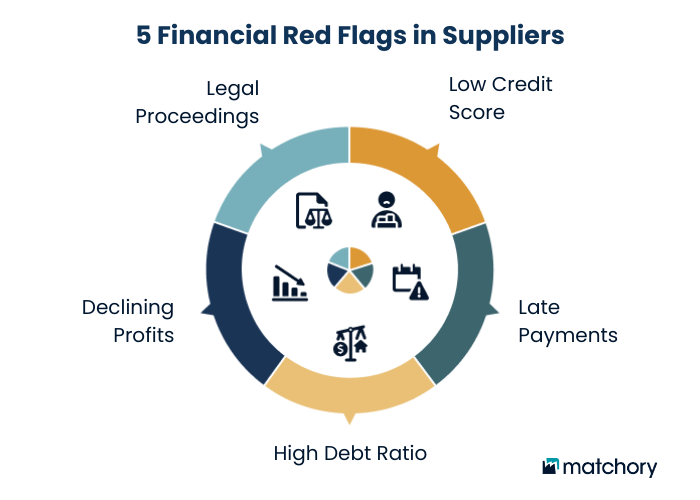
Credit scores aren’t just for consumers. For businesses, they’re a concise measure of financial reliability, based on payment history, debt load, and public records. A healthy score usually means a supplier has the discipline (and liquidity) to meet its obligations.
The danger comes when that score is falling. A downward trend can signal deepening cash flow strain, missed payments to their own suppliers, or mounting legal trouble. That financial instability can quickly translate into your shipments arriving late or not at all.
Modern procurement teams no longer have to rely on outdated reports. Credit agencies like Creditsafe, Dun & Bradstreet, and Experian update their databases daily, and many AI-powered platforms now integrate directly with these sources. That means you can track trends over time, set minimum score thresholds for onboarding, and receive instant alerts if a partner’s score drops.
Checking a supplier’s credit score is a bit like watching a weather forecast: one low reading may not ruin your day, but a steady downward pattern means you’d better pack for a storm.
If credit scores are a forecast, late payment history is a real-time weather report. It shows you exactly how a supplier has been treating its financial obligations in recent months.
A supplier who pays late once might be dealing with an administrative hiccup. A supplier whose “days beyond terms” swings wildly — 12 days one month, 57 the next — is showing you a much more serious liquidity problem. That volatility is often a precursor to delivery delays, production stoppages, or price changes designed to shore up cash.
Unfortunately, many procurement teams don’t check payment histories until problems arise. Trade payment databases make it simple to verify a supplier’s track record before signing a contract. Combine that with references from peers in the industry, and you can build a clear picture of a partner’s reliability.
In tight markets, some suppliers are victims of late payments themselves, especially in sectors like chemicals or machinery where over half of firms report delays beyond 30 days. But if late payments are a recurring pattern, it’s a red flag you can’t afford to ignore.
How a supplier finances its business says a lot about its long-term stability. The debt-to-equity (D/E) ratio compares how much capital comes from borrowing versus shareholders.
A high D/E ratio isn’t automatically bad. Capital-intensive industries like transport or utilities naturally run higher ratios than, say, software firms. But when a supplier’s ratio exceeds industry norms, it can mean trouble.
Over-leveraged companies are more vulnerable to interest rate hikes, economic slowdowns, or even small market shifts. Servicing debt drains cash from operations, leaving less for maintenance, innovation, or capacity growth. In severe cases, high debt levels lead to restructuring or bankruptcy, and sudden supply chain gaps for you.
When reviewing D/E ratios, context is critical. Compare suppliers against industry benchmarks, factor in company size, and look for trends over time. A spike after a major expansion might be justifiable. A spike to cover operating losses is a warning siren.
Profit margins reveal a company’s breathing room. When margins are healthy, suppliers can reinvest in quality, talent, and innovation. When margins shrink, especially for several consecutive periods, they’re more likely to cut corners or delay projects just to stay afloat.
This kind of margin pressure can come from rising input costs, stagnant pricing power, or losing ground to competitors. Whatever the cause, the impact is the same: long-term sustainability is at risk.
Early warning signs include postponed capital projects, sudden pricing changes, or generous credit terms to boost sales. Reviewing quarterly financials, not just annual statements, can help you spot these patterns before they snowball.
Margins can decline slowly, almost imperceptibly, but their effects are cumulative. Left unchecked, they can trigger a downward spiral that affects every part of a supplier’s operations (and eventually, yours).
While the other four red flags point to potential trouble, legal filings confirm it. Court judgments, winding-up petitions, or formal insolvency proceedings mean a supplier is already in distress.
In some cases, such as administration in the UK, a supplier may continue operating while restructuring. In others, like liquidation, operations end entirely. Either way, your leverage diminishes the moment formal proceedings begin.
The good news is that many suppliers show multiple distress signals months before legal action. Declining credit scores, erratic payment behavior, and shrinking margins often appear in combination. By monitoring these metrics and staying in close contact with industry peers, you can often spot trouble long before the courts get involved.
Catching these red flags is one thing; building them into your process is another. The most resilient procurement teams embed financial checks at every stage:
Financial warning signs rarely exist in isolation. A supplier under margin pressure may start paying late, damaging its credit score, and ultimately face legal trouble. Recognizing these patterns gives you a chance to act early, whether that means diversifying suppliers, renegotiating terms, or collaborating on solutions.
In a volatile market, proactive financial risk management isn’t just about avoiding disaster. It’s about building a more resilient, responsive supply chain that can adapt to whatever comes next. By combining clear-eyed financial analysis with modern AI-driven tools, procurement teams can move from reactive firefighting to strategic foresight. And when your competitors are caught scrambling for replacements, you’ll already have a plan in place and the suppliers to execute it.

Schedule a product demo video call with a supplier scouting expert.
 Book a demo



Sit back and get a quick overview of the features of the Matchory platform.

Tell us your inquiry and get in touch with the respective expert.